DESI — Mapping Dark Energy
Mayall 4-metre Telescope, Kitt Peak · 2024–
Four experiments spent forty years establishing what matter is made of. DESI asks a different question: what is the 95% of the universe that is not made of it?
The Dark Energy Spectroscopic Instrument places 5,000 robotically positioned optical fibres at the focus of the Mayall telescope, taking thousands of galaxy spectra at a time. Each spectrum gives a redshift, and each redshift gives a distance. Assembled over a five-year survey completed in May 2026, they form the largest three-dimensional map of the universe ever made.
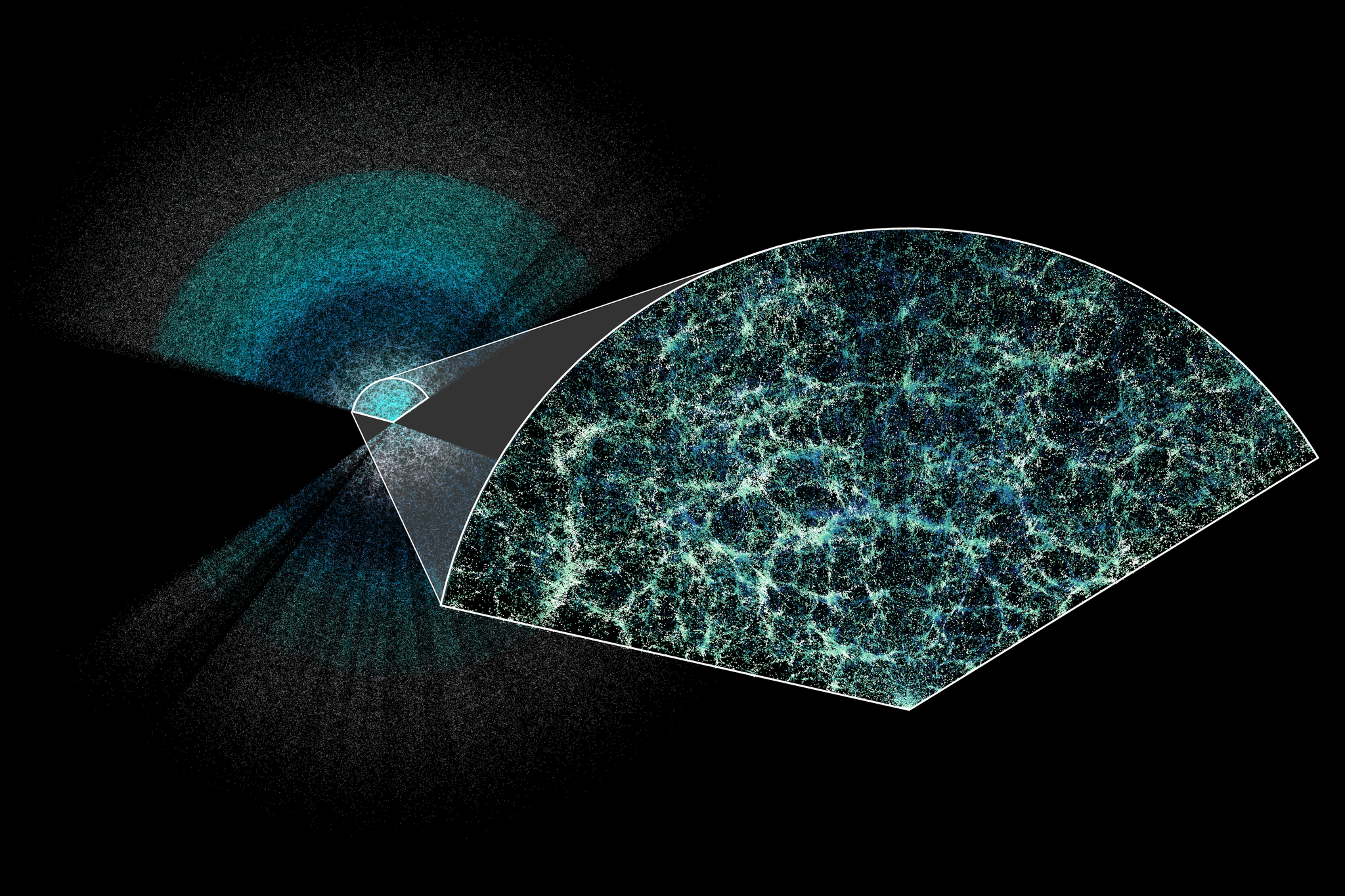
The map carries a standard ruler. Sound waves in the plasma of the early universe froze out at recombination, leaving a preferred separation between galaxies of about 150 megaparsecs. Measuring that scale at a range of redshifts traces how fast the universe was expanding at each epoch — and so what dark energy has been doing.
The result has been the surprise of the field. Combined with the cosmic microwave background and supernovae, DESI's measurements prefer a dark energy density that evolves with time over Einstein's constant, at a significance that has grown with each data release. The same data constrain the sum of the neutrino masses — a particle physics measurement made by surveying galaxies.
Boston University in DESI
Boston University is one of DESI's 72 participating institutions. The group contributes to the instrument, to survey operations, and to the cosmological analysis — the baryon acoustic oscillation measurements that fix the expansion history, the full-shape clustering analyses that measure the growth of structure, and the Lyman-α forest programme that carries both to redshifts beyond the reach of galaxy surveys.
Those measurements feed a single question. Combined into a cosmological parameter estimation, they constrain the equation of state of dark energy and the sum of the neutrino masses — a particle physics result obtained by mapping galaxies. The group's own pages describe each strand:
- ResultsBAO, full-shape clustering and parameter estimation
- Baryon acoustic oscillationsthe standard ruler, from galaxies, quasars and the Lyman-α forest
- Full-shape clusteringgalaxies and quasars, and the Lyman-α Alcock-Paczyński measurement
- Cosmological parameter estimationdark energy, neutrino mass and extended models
- Lyman-α forest programmehow the measurement is built, the pipeline, and the 1D power spectrum
- Data Release 118.7 million high-confidence redshifts
- Publicationsinstrument, data and cosmology papers, filterable by topic
- The groupcurrent and prior members at Boston University
- My DESI papersRohlf, 12 papers
Outreach and images
DESI is unusually photogenic for a cosmology experiment — 5,000 robotic fibre positioners on a telescope built in 1973, on a mountain in the Sonoran Desert. These pages collect the public material.
- Public resourcesvideos, data releases and outreach links
- Photographscryostat construction, collaboration meetings, and the mountain
- Hardware postersthe instrument in detail, courtesy Claire Poppett
- Talksconference and public talks by the group
- Boston University DESIthe group's home page
- DESI Collaboration