CMS — Discovery of the Higgs Boson
Large Hadron Collider, CERN · 1991–
Finding the W and Z confirmed that the weak bosons are heavy. It did not explain why. The mechanism proposed in 1964 required a field filling all of space, and one more particle as its signature. Forty-eight years later, two experiments at the Large Hadron Collider found it.
CMS is a general-purpose detector the size of a small building, wrapped around one of the LHC's collision points. On 4 July 2012, CMS and ATLAS jointly announced the observation of a new boson near 125 GeV, seen most clearly in its decays to two photons and to four leptons. It has since been established as the Higgs boson, with couplings that scale with mass exactly as the theory demands.
Observation of a New Boson at a Mass of 125 GeV with the CMS Experiment at the LHC
Physics Letters B 716, 30 (2012)
16,900 citations
10.1016/j.physletb.2012.08.021
François Englert and Peter Higgs received the Nobel Prize in Physics in 2013, awarded explicitly for a mechanism “confirmed through the discovery of the predicted fundamental particle by the ATLAS and CMS experiments”. It is among the most cited results in the history of physics.
Jet angular distributions
One measurement runs the whole length of Rohlf's career. At Fermilab in 1977 he helped show that hadrons collide through their constituents by finding jets. At the CERN collider in 1986, UA1 measured the angle at which those jet pairs come out and found the Rutherford form — evidence that the force between quarks goes as 1/r², that the gluon has spin 1, and that quarks are point-like to the resolution available.
CMS made the same measurement at the LHC, at roughly twelve times the collision energy and with a correspondingly finer resolution. The dijet angular distributions again agree with QCD, and the absence of any excess at wide angle pushes the limit on quark substructure far above where UA1 could reach. Quarks are still point-like, now tested to a much shorter distance.
Measurement of Dijet Angular Distributions and Search for Quark Compositeness in pp Collisions at √s = 7 TeV
Phys. Rev. Lett. 106, 201804 (2011) 115 · DOI
Heavy ions and the quark-gluon plasma
Protons are not the only thing the LHC collides. Twice a year it accelerates lead nuclei, and for an instant the collision produces matter hot and dense enough that quarks and gluons are no longer confined inside individual hadrons — a quark-gluon plasma. It is the state the whole universe was in for its first few microseconds, before it cooled enough for protons and neutrons to form.
Two of CMS's measurements pin it down. The first uses jets: a quark scattered inside the medium has to fight its way out, losing energy on the way, so pairs of jets that should be balanced come out lopsided. That is jet quenching, and it is a direct measure of how strongly the medium interacts. There is a pleasing circularity in it — the jets Rohlf helped establish in 1977 as evidence that quarks exist are now the calibrated probe used to study what quarks do when they are set free.
The second is a thermometer. The Υ states are bottom quark–antiquark pairs of different sizes and binding energies, and a hot medium dissolves the loosely bound ones first. CMS measured all three at once and found exactly that ordering: relative to proton–proton collisions, the Υ(2S) is strongly suppressed in lead–lead and the Υ(3S) essentially disappears.
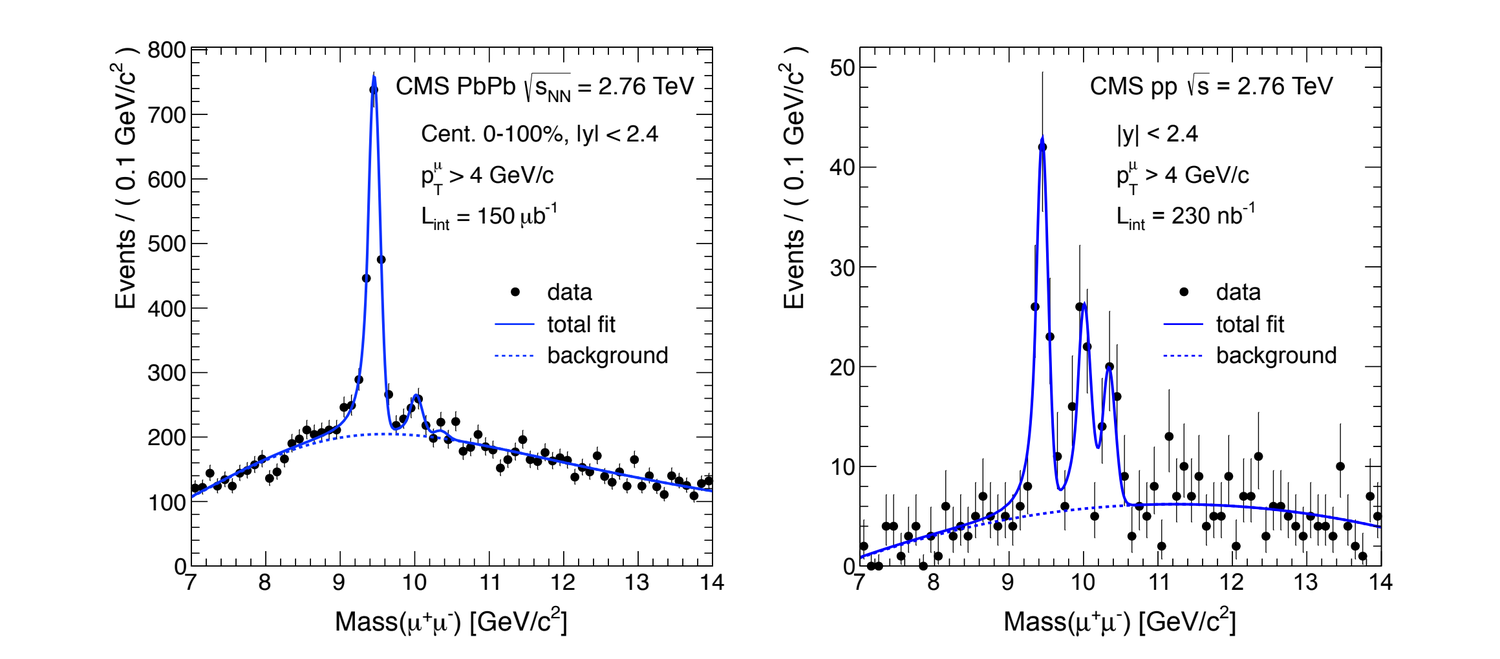
Observation and Studies of Jet Quenching in PbPb Collisions
Physical Review C 84, 024906 (2011)
1,090 citations
10.1103/PhysRevC.84.024906
Observation of Sequential Υ Suppression in PbPb Collisions
Phys. Rev. Lett. 109, 222301 (2012) 429 · DOI
Study of High-pT Charged Particle Suppression in PbPb Compared to pp Collisions
Eur. Phys. J. C 72, 1945 (2012) 693 · DOI
Multiplicity and Transverse Momentum Dependence of Two- and Four-Particle Correlations in pPb and PbPb Collisions
Phys. Lett. B 724, 213 (2013) 650 · DOI
Rohlf is an author on more than 100 CMS heavy-ion papers, on collective flow, quarkonium suppression, jet shapes, photon–jet correlations and light-by-light scattering. Taken with DESI, his measurements span the universe from its first microseconds to the present day.
Hardware
Discoveries at a hadron collider are made by instruments that have to be invented first, and then rebuilt as the machine's luminosity climbs. Twenty-five years of that work run through Rohlf's CMS papers, in a line that starts at the calorimeter and ends at the data acquisition system.
The route in — drift tubes for the SSC
The hardware line begins before CMS existed. Planning for the Superconducting Super Collider raised a question nobody had faced: whether gas-filled tracking detectors could survive, and keep resolving tracks, in the radiation of a hadron collider far more intense than anything then running.
The Boston University group built the answer and then abused it. Their drift tubes were 1.9 mm in radius with 25-micron walls; a twenty-three-tube prototype reached a single-tube resolution of 90 microns on cosmic rays, running on a half-and-half mixture of argon and ethane. Tubes of the same design were then carried to the MIT Research Reactor and left in the neutron and gamma flux from uranium fission for 450 hours, accumulating 1.3 × 10¹⁴ neutrons/cm² above 0.5 MeV and drawing 0.8 C/cm of accumulated charge — a dose meant to stand in for years at the SSC.
The SSC is also how Rohlf arrived at CMS. The Boston University group belonged to L*, one of the detectors proposed for the Texas machine, and among its 826 authors the BU contingent ran fifteen strong: S. Ahlen, G. Bauer, J. Beatty, J. Brooks, T. Coan, M. Felcini, J. Hu, D. Levin, W. Lu, A. Marin, S. Otwinowski, D. Osborne, J. Rohlf, D. Warner and B. Zhou.
Steve Ahlen's part in the SSC effort was central — he is first author on the drift-tube design paper below. Ahlen had come to the SSC from dark matter searches, Rohlf from the W and Z at UA1.
What they did next was a choice rather than an accident. With Texas cancelled, the easy and safe course would have been for the two of them to join the same LHC experiment and keep the group together. Instead each followed his own expertise. Ahlen's was tracking — the subject of those very drift tubes. Rohlf's was calorimetry, a line running back through the missing energy that found the W at UA1 to the calorimeter trigger on E260. Tracking took Ahlen to ATLAS. Calorimetry took Rohlf to CMS, and to the hadron calorimeter work below.
Thirty years later they converged again on DESI, where both are members of the BU group and co-authors on its Physical Review Letters paper on neutrino masses.
dark matter → SSC → ATLAS → DESI · W and Z → SSC → CMS → DESI
Expression of Interest to the Superconducting Super Collider Laboratory by the L* Collaboration
Letter of Intent to the Superconducting Super Collider Laboratory by the L* Collaboration
November 1990 · SSC-LOI0002, SSCL-SR-1154 · INSPIRE
When the SSC was cancelled in 1993 those groups dispersed, and much of the effort — people, techniques and the hard-won knowledge of how detectors behave in hadron-collider radiation — went to CERN. The question the SSC had posed was waiting at the LHC unchanged, and small drift tubes went on to be used for muon tracking at high rate.
Performance of Small Radius, Thin Wall Drift Tubes in an SSC Radiation Environment
B. Zhou, D. Warner, J. Rohlf, D. Osborne,
A. Marin, W. Lu, G. Hopkins, T. Coan, J. Beatty, S. P. Ahlen
IEEE Trans. Nucl. Sci. 37, 1564 (1990)
· DOI
· preprint PDF
BUHEP-90-2
Design and Performance of Drift Tubes for Tracking at High Luminosity Hadron Colliders
S. P. Ahlen, G. Bauer, J. Beatty, T. Coan, G. Hopkins, K. Kwok,
W. Lu, A. Marin, D. Osborne, J. Rohlf, D. Warner, B. Zhou
Particle World 1, 168 (1990)
The Data Concentrator Card
A calorimeter produces far more channels than any single link can carry. The front-end electronics has to be gathered, formatted, checked and merged into a stream the central data acquisition system can accept — and it must all happen at the collision rate, without pausing.
The Data Concentrator Card is the board that does this for the CMS hadron calorimeter, built at Boston University with Maryland in the VME era of the experiment. Two generations were produced. The DCC is the direct ancestor of the AMC13 below: the same job, redone when CMS changed crate standard.
The CMS HCAL Data Concentrator: A Modular, Standards-Based Implementation
E. Hazen, J. Rohlf, S. Wu, A. Baden,
T. Grassi
7th Workshop on Electronics for LHC Experiments, 347 (2001)
Characterising the hadron calorimeter
A calorimeter is only as good as what you know about it. Before CMS could measure a jet it had to be established, wedge by wedge, how much light each layer produced, how the response varied across the detector, and how to calibrate it — work done on test beams and then written up as the reference description of the built hardware. Rohlf led and wrote these papers for all three parts of the hadron calorimeter: the barrel, the outer and the endcaps.
Design, Performance, and Calibration of the CMS Hadron-Barrel Calorimeter Wedges
Eur. Phys. J. C 55, 159 (2007) 133 · DOI
Design, Performance, and Calibration of the CMS Hadron-Outer Calorimeter
Eur. Phys. J. C 57, 653 (2008) 50 · DOI
Design, Performance, and Calibration of the CMS Hadron Endcap Calorimeters
CMS Note (2008) 8 · INSPIRE
Synchronisation and timing
Thirty-nine thousand calorimeter channels are useless unless they agree on when “now” is. Every channel has to be aligned to the same 25-nanosecond bunch crossing, and kept there — which means measuring each one's delay, correcting it, and proving on real data that the whole detector reads the same clock.
Rohlf led and wrote this work too, first as the design of the synchronisation scheme and then as its demonstration on test beam, cosmic ray and LHC beam data. It is also where the AMC13 line begins: distributing timing and trigger across a large detector is precisely the problem that card was later built to solve.
Synchronization and Timing in the CMS Hadron Calorimeter
CMS Note (2007) · INSPIRE
Performance of CMS Hadron Calorimeter Timing and Synchronization using Test Beam, Cosmic Ray, and LHC Beam Data
JINST 5, T03013 (2010) 57 · DOI
AMC13 — trigger and readout
CMS then moved its off-detector electronics from VME crates to the MicroTCA standard, and every such crate needs one card to do what the payload boards cannot do for themselves: fan the LHC clock and the Level-1 trigger out to the other cards, collect their data and ship it to the central data acquisition system, and carry back the throttling signals that stop the experiment being read out faster than it can be recorded.
That card is the AMC13, developed at Boston University and named for the dedicated thirteenth slot it occupies. It began as a MicroTCA Carrier Hub study in 2010 and became the timing, trigger and DAQ module used across CMS subsystems — the largest of Rohlf's electronics contributions to the experiment.
The AMC13XG: A New Generation Clock/Timing/DAQ Module for CMS MicroTCA
E. Hazen, A. Heister, C. Hill, J. Rohlf,
S. X. Wu, D. Zou
JINST 8, C12036 (2013)
· DOI
Development of a MicroTCA Carrier Hub for CMS at HL-LHC
M. Dimitriyev, E. Hazen, S. X. Wu, J. Rohlf
JINST 5, C12042 (2010)
· DOI
Photodetectors and trigger primitives for the hadron calorimeter
The CMS hadron barrel calorimeter is layers of plastic scintillator sandwiched in brass; the light from each tile travels out along a wavelength-shifting fibre and has to be turned into a signal inside a 4-tesla magnetic field. Silicon photomultipliers — then still called G-APDs — promised far higher gain than the original photodetectors and indifference to the field, but had to be shown to work with the calorimeter's existing front-end electronics, and then in a real beam.
Performance of Silicon Photomultipliers with the CMS HCAL Front-End Electronics
A. Heering, J. Rohlf, J. Freeman, S. Los,
S. Kuleshov, Y. Musienko
Nucl. Instrum. Meth. A 576, 341 (2007)
· DOI
An 18-Element Strip of 1 mm² G-APDs for the CMS HCAL Upgrade: Results of CERN Test Beam 2009
A. Heering, J. Rohlf, S. Los, J. Anderson,
J. Freeman, Y. Musienko, I. Schmidt, C. Tully, S. Dugad
IEEE Nuclear Science Symposium (2009)
· DOI
Radiation Damage Studies on SiPMs for Calorimetry at the Super LHC
A. Heering, P. Bohn, A. Clough, E. Hazen, J. Rohlf,
S. Los, J. Freeman, E. Cascio, Y. Musienko, C. Piemonte
IEEE Nuclear Science Symposium, 1523 (2008)
· DOI
Radiation Damage Studies of Silicon Photomultipliers
P. Bohn, A. Clough, E. Hazen, A. Heering, J. Rohlf,
J. Freeman, S. Los, E. Cascio, S. Kuleshov, Y. Musienko, C. Piemonte
Nucl. Instrum. Meth. A 598, 722 (2008)
· DOI
Silicon photomultipliers are now what the CMS hadron calorimeter reads its light with.
Rohlf also worked on the calorimeter's trigger primitive mapping — the correspondence between the calorimeter's readout channels and the coarser trigger towers the Level-1 trigger actually sees. Get that mapping wrong and the trigger forms its energy sums from the wrong parts of the detector, so nothing downstream can be trusted.
Apollo: ATCA electronics for the HL-LHC
The High-Luminosity LHC will deliver collisions at a rate the present trigger and readout cannot survive. Apollo is the answer built at Boston University with Cornell: an ATCA blade split into a general-purpose Service Module, carrying a system-on-module computer and the standard shelf communications, and an application-specific Command Module holding large FPGAs and high-speed optical links. The same platform serves both the CMS track finder and the pixel readout.
Design, Construction, and Testing of the Apollo ATCA Blades for Use at the HL-LHC
JINST 20, C04001 (2025) · arXiv:2501.03702 · DOI
The Apollo ATCA Design for the CMS Track Finder and the Pixel Readout at the HL-LHC
JINST 17, C04033 (2021) · arXiv:2112.01556 · DOI
The Apollo ATCA Platform
PoS TWEPP2019, 120 (2019) · arXiv:1911.06452 · DOI
A long programme
The Higgs discovery is one paper out of about 1,600 that Rohlf has co-authored with CMS. The collaboration measures the Higgs boson's properties to ever finer precision — its couplings, its width, whether it interacts with itself — and searches the energy frontier for anything the Standard Model does not predict: supersymmetry, extra dimensions, dark matter produced in collisions, heavy resonances, long-lived particles.
Rohlf was the major contributor of the hadron calorimeter, jets and missing transverse energy sections of the collaboration's founding physics document, CMS Physics: Technical Design Report Volume 1 — Detector Performance and Software (2006), which set out how the detector would be used before it had taken a single collision.
CMS Physics: Technical Design Report Volume 1 — Detector Performance and Software
CERN-LHCC-2006-001 (2006) 1,174 · INSPIRE
All CMS papers on INSPIRE · About CMS
Citation counts from INSPIRE-HEP, August 2026.